Projection in Bright Environments: High Ambient Light & Daylight Projection
High ambient light projection is challenging, but with the right screen and setup, you can still achieve a bright, clear image—even in high ambient light. Learn about front projection, rear projection, and how to get the best results in bright environments.
Patrick Argall
5/8/20243 min read
One of the biggest challenges in projection technology is dealing with high ambient light environments—especially daylight projection. Projectors and screens have come a long way, but at the end of the day, you’re up against the sun—the most powerful light source we know.
Still, with the proper setup, getting a bright, viewable image is possible even in well-lit spaces. And from my experience, not all screens are up to the task.
The Reality of Daylight Projection
Years ago, I tested a Quintessence projection screen against several other screens in direct sunlight. The screens failed—but ours was the only one still producing an image.
Now, I won’t claim that the image was perfect (after all, you’re competing with the sun), but the fact that it was visible was impressive. And that’s the key when working with high ambient light—you need to maximise projected light return to the audience while keeping brightness as uniform as possible across the viewing field.
How to Get the Best Results in High Ambient Light
✔ Use a High-Power Projector – The brighter the projector, the better. Look for projectors with high lumen output (at least 5,000+ lumens, the more extreme the environment, the more lumen).
✔ Maximise Light Return – A Quintessence screen is engineered to return a very high percentage of projected light to the audience, ensuring maximum performance and visual clarity.
✔ Understand Screen Gain & Viewing Angle –
The higher the screen gain, the narrower the reflected light beam.
A Bellatini screen, which relies on microsphere lenses, can produce a stunning image—but only for about three people sitting directly behind the projector.
On the other hand, a Quintessence screen provides uniform brightness across nearly 180°, ensuring everyone in the room gets a bright, clear image.
✔ Control the Environment Where Possible – If you can’t block sunlight entirely, angled projection, controlled lighting, or light-shielding structures can improve results.
When it comes to high ambient light, the key is directing as much projected light back towards your audience while keeping brightness uniform. And that’s where screen technology makes all the difference.
Rear Projection: A Smart Solution for Bright Spaces
One of the best ways to overcome high ambient light issues is to use rear projection. This setup places the projector behind the screen, ensuring that the audience only sees the transmitted light rather than competing with reflections from other light sources.
But, like everything in projection, some key factors must be considered.
What Makes Rear Projection Effective?
✔ Ambient Light Control – Since the projector is behind the screen, ambient light doesn’t wash out the image to the same extent.
✔ Short-Throw Projectors Work Best – The shorter the throw distance, the wider the viewing angle, making short-throw projectors an excellent choice for rear projection setups.
✔ Architectural Considerations – Rear projection often requires dedicated space behind the screen, meaning:
You need room for the projector, but a short or UST projector requires the least space.
You might need mirrors to fold the projection path in tight spaces.
If it’s an outdoor or temporary installation, a housing structure may be necessary to block out ambient light.
Potential Downsides of Rear Projection
Hotspotting Risks – If the audience is juxtapositioned to look directly at the projector lens through the screen, a bright hotspot will probably appear in the image. Proper screen selection and projector placement help minimise this issue.
Limited by Available Space – If the architecture of your building doesn’t allow for enough rear projection depth, it may not be an option.
Despite these challenges, rear projection remains one of the most effective solutions for high ambient light environments—provided you can accommodate the projection space requirements.
Which Projection Setup is Best for You?
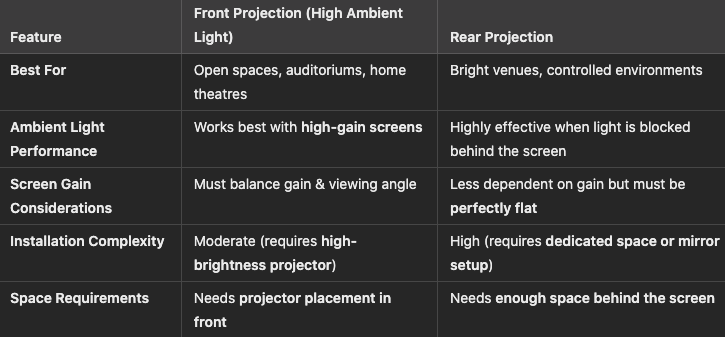
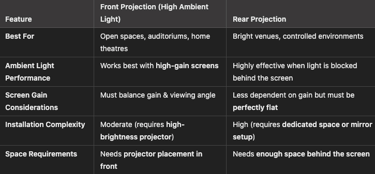
If your goal is to achieve the best image quality in high ambient light, consider:
✔ Front projection with a high-gain screen if your audience is spread wide and you need a uniformly bright image.
✔ Rear projection if you have the space and need to shield the image from ambient light.
Either way, the screen is the critical element—it determines how well the projector’s light is converted, or retroreflected. The resultant image quality and how consistent the image remains.
And when it comes to delivering the highest light return with an ultra-wide viewing angle, a Quintessence screen leads the pack.