
Standard Throw, Short Throw or Ultra Short Throw? Choosing the Best Projector for Your Application and Space
Thinking about Front or rear Projection, Standard, Short or Ultra Short Throw (UST) for your home theatre? Learn the key differences, including room size considerations, screen compatibility, and installation requirements to help you choose the best option for your space.
Patrick Argall
5/8/20244 min read
If you’re considering a projection system, Front or Rear is the first decision you’ll need to make, then whether to go with a standard throw, short throw, or ultra short throw (UST) projector. And trust me, this isn’t just about picking a projector—it’s about understanding your space, how you’ll use it, and what kind of experience you want to create.
So, before we dive into the differences, let’s start with the most important question:
What Factors Should Influence Your Choice?
1. Front or Rear Projection
You probably know which route already; this is driven by application, architecture and ambient light
2. Application, Room Size & Layout
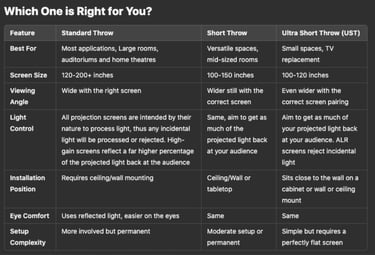
Standard throw projectors are ideal for larger rooms where you can mount the projector a reasonable distance from the screen. In a lecture application, this will cast a shadow of the lecturer.
Short throw, projectors require less space, and will more than likely produce a smaller lecturer shadow.
UST projectors sit just decimeters from the screen, on a cabinet below the screen or inversion mounted just above the screen, making them great for smaller spaces particularly if you don’t want to mount anything on the wall or ceiling. These are great for lecturer/teaching applications as shadowing is almost eliminated.
3. Screen Size & Viewing Distance
Standard throw projectors enable the largest screens—120 inches, 150 inches, or even more—for an authentic cinematic experience.
Short throw projectors can still offer large screens with a broader viewing angle typically 1 to 2.5m throwing distance and more to project a large image.
UST projectors are usually limited to 100-120 inch screen, so if you want a massive wall-filling display, standard throw has the edge.
4. Light Control & Ambient Light
If your space has large windows or significant ambient light, a Quintessence high-gain front projection screen will perform far better than a Lambertian screen. You can actually get away with a lesser projector and still achieve a fantastic result.
UST projectors require an absolutely flat screen surface, but due to the amphoric mirror, the image size is limited before the edges lose their zest; they can’t match the clarity of a well-paired standard throw setup.
5. Installation & Aesthetics
Projectors require planning—mounting the projector, running cables, and positioning the screen correctly.
UST projectors sit close to the wall, making installation easier, but they require cabling and a perfectly flat screen is essential; any imperfections will distort the image.
Now that you know the primary considerations, let’s compare these projection types in detail.
Standard Throw Projection – The Ultimate Cinematic Experience
I’ll be honest—standard throw projection is my favourite. And with a Quintessence screen, it simply outperforms others, whether in high or low ambient light.
Why Standard and Short Throw Stands Out:
✔ Picture quality - that's the whole point of Quintessence screens' existence and our inordinate time in development. If around 90% of the information our brains take in is visual, surely this should be the installation's focal point.
✔ A Wider Viewing Cone – Thanks to the way light reflects off a high-quality gain screen, a much broader viewing angle/cone results - the same for UST. Check, the brightness should remain uniform across the screen. Step inside the viewing zone, and the image is vibrant. Step outside, and you’ll see an apparent drop-off—it’s almost like stepping in and out of the picture.
✔ Discreet, Minimalist Design – The Quintessence Zero Bezel screen is only 25mm thick, so it sits elegantly on your wall. And if you don’t like the idea of a blank screen taking up space during the day? Simply project digital art onto it, giving it a stylish, functional dual-purpose: art or massive photo frame by day, entertainment by night
✔ Bigger Than Any TV – If you want a truly massive screen, standard throw projection is the only way to go. TVs and UST projectors max out at around 100-120 inches, as will your pocket; but with standard throw projection, you're only limited by your wall size and throwing distance.
Ultra Short Throw (UST) – A Space-Saving Alternative
Ultra Short Throw (UST) projectors are a great choice if you don’t have the space for a ceiling-mounted projector but still want something larger than a TV. However, there are a few things to keep in mind.
What You Need to Know About UST Projection:
✔ Great for Limited Spaces – UST projectors sit just decimetres from the screen, If you’re tight on space and don’t want to mount a projector on the ceiling, a UST setup is a solid choice if you pair it with a high-performance, perfectly flat screen. No long cables—plug and play and great for lecture/teaching applications.
✔ The Lens Design Matters – UST projectors use an anamorphic lens, which means that screen flatness is critical. Any wrinkles, waves, or curvature in the screen will distort the image—even the slightest imperfections can ruin the viewing experience.
✔ Forget Roll-Up Screens – While tab-tensioned roll-up screens are an improvement, they still don’t match the image quality of a fixed-frame screen. You need a rigid, perfectly flat surface if you're using UST.
Short Throw – The Middle Ground
Short throw projectors offer as the name suggests a shorter throw lense, making them an excellent option for people who want a large image with a limited throw distance.
Advantages of Short Throw Projectors:
✔ Less Installation Hassle – Short throw projectors require less distance from the screen than standard throw models but don’t need the extreme precision of UST setups.
✔ Big Screen Potential – They can still achieve 100-150 inches without the space requirements of standard throw projectors.
✔ Less Sensitive to Screen Imperfections – Unlike UST projectors, short throw models don’t require a perfectly flat screen, however deviations in focal length (screen wrinkles or waves) alter the focal distance and thus the image quality and depth of field.

Final Thoughts
If you want the biggest, most immersive experience with the best picture quality, standard throw projection with a high-quality screen is unbeatable.
If space or shadowing is a constraint and you want a TV replacement with minimal installation, a UST setup can work well—but only if you pair it with a perfectly flat, high-quality screen.
Short throw projectors offer a middle-ground solution, balancing screen size, installation requirements and flexibility.
Either way, the screen makes the image and thus all the difference. A Quintessence screen delivers the best results in all three setups, where it outshines (pardon the pun) everything else in bright and dark conditions.